Translate

Saturday, March 23, 2013

Foxtrot- Kamalia Blunt


                                 Foxtrot
The Birth and Father-Foxtrot was born in the summer of 1914 by Harry Fox, a Vaudeville actor, whose original name was Arthur Carringford. At age fifteen for a short time, he joined the circus and afterward, played professional baseball. In 1904, Fox debuted in a comedy entitled “Mr. Frisky of Frisco” at Belvedere Theatre after a music publisher discovered his vocal talent. After a earthquake and fire in San Francisco where he lived, Fox traveled East and stopped in New York.

Creating the Movement:

Fox, in early 1914, appeared in many vaudeville shows in the New York area, and teamed with Yansci Dolly of the Dolly Sisters in a Hammerstein’s act. During this time, the New York Theatre was undergoing a conversion into a movie house. As an added attraction, vaudeville acts were performed between shows and Harry Fox and his “American Beauties” were selected to perform. As the movie theatre was changing, its roof turned into a Jardin de Danse, where the Dolly sisters made frequent performances. It was here on the roof top where dance was born, the name Foxtrot came as Harry performed trotting steps in his vaudeville acts to ragtime music. Thus, people referred to this dance as the “Fox’s Trot.”

 So You Think You Can Dance: Foxtrot

http://www.youtube.com/watch?v=AWpnYV3S8Kk

Citation:
Fuller, Jake. "Foxtrot:History of Dances." Dance, Fitness, and Sports Store. CentralHome.com Company, Inc.. Web. 13 Apr 2013. <http://www.centralhome.com/ballroomcountry/foxtrot.htm>.

Thursday, March 21, 2013

Swing Jazz-Jamila Jenkins

                             Jazz & Swing
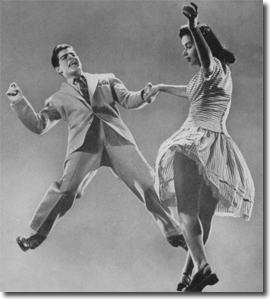
Jazz dance can be traced back to Africa before slavery. However, swing dance does not have as much detail about whom or where it originated. What we do know is that it originated in the early 1900s in Southeast America by the African American communities. The name was coined from swing music, a specialized jazz music that gave people the ability to be more open with their body movement. Swing dance differed from other dances in America because it was about more than just the beauty of the point toe and all the straight leg work. The dancers weren’t known as swing dancers but instead terms like jitterbugs rang a ball when swing dance started.

There are many types of swing dances like East Coast Swing and West Coast Swing. Out of all the different styles of swing dancing, Lindy Hop is very popular and originated in Harlem, New York. As the name might hint, it is a very energetic style of dance that is not hard to learn once some practicing is done. It is done in 6 and 8 counts and is of course a partner dance like most swing dances. Popular swing dancers include Frankie Manning during the Harlem Renaissance and Benji Schwimmer now in the 21st century.

Swing Jazz Dancing 
 http://www.youtube.com/watch?v=mxPgplMujzQ   http://www.youtube.com/watch?v=EcbU0qY1VT0

Classical Ballet-Jamila Jenkins


                                                 Ballet Classical
Swan Lake
After the stunning Romanticism era, Classical ballet stole the show with its extraordinary techniques and altered costumes. Rotations of the ballerina’s lower body, more specifically, the hips, thighs and feet made classical ballet stand out tremendously. This later became known as turnouts. In order to see the turnouts, the old tutus used during the romanticism era would not be appropriate because of their long length. The tutus would have to become shorter in order for the audience to see the ballerina’s technique. Virgina Zucci, an Italian ballerina, was the first to wear the tutu in the 1880s.At first the new short tutus were considered vulgar and tasteless but were eventually overlooked.
Virginia Zucci
            Classical ballet originated in Italian Renaissance where it later traveled to France and from there all over the world. As the dance became more developed, it beame a concert concentrated dance. During the performance, the ballet is broken down into acts. An important act is the second one, known as a Grande Pas de Deux (G.P.D.). The G.P.D. includes an adage (the beginning), a male variation, a female variation and the Grande Allegro which is the end where both the male and female lead come together and perform at a faster pace. Unsurprisingly, classical ballet is accompanied by classical music. Some popular composers include Beethoven, Bach and Mozart.
·      
                                                          Swan Lake: